
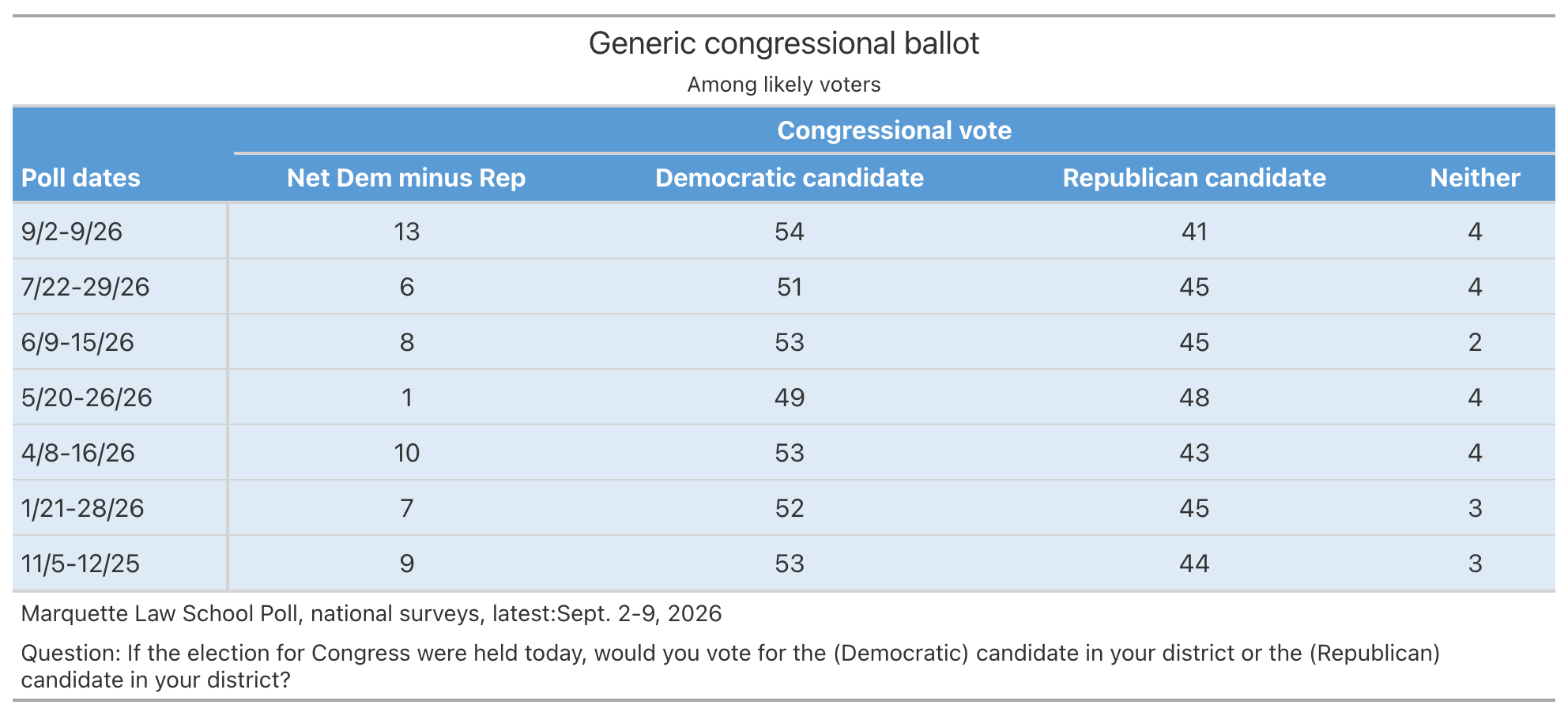
A new Marquette Law School Poll national survey finds 54% of likely voters saying they will vote for a Democrat in congressional elections in November, while 41% say they will vote for a Republican. In July, the Democratic advantage was 51% to 45%. The recent results for the congressional vote among likely voters are shown in Table 1. (All results in the tables are stated as percentages.)
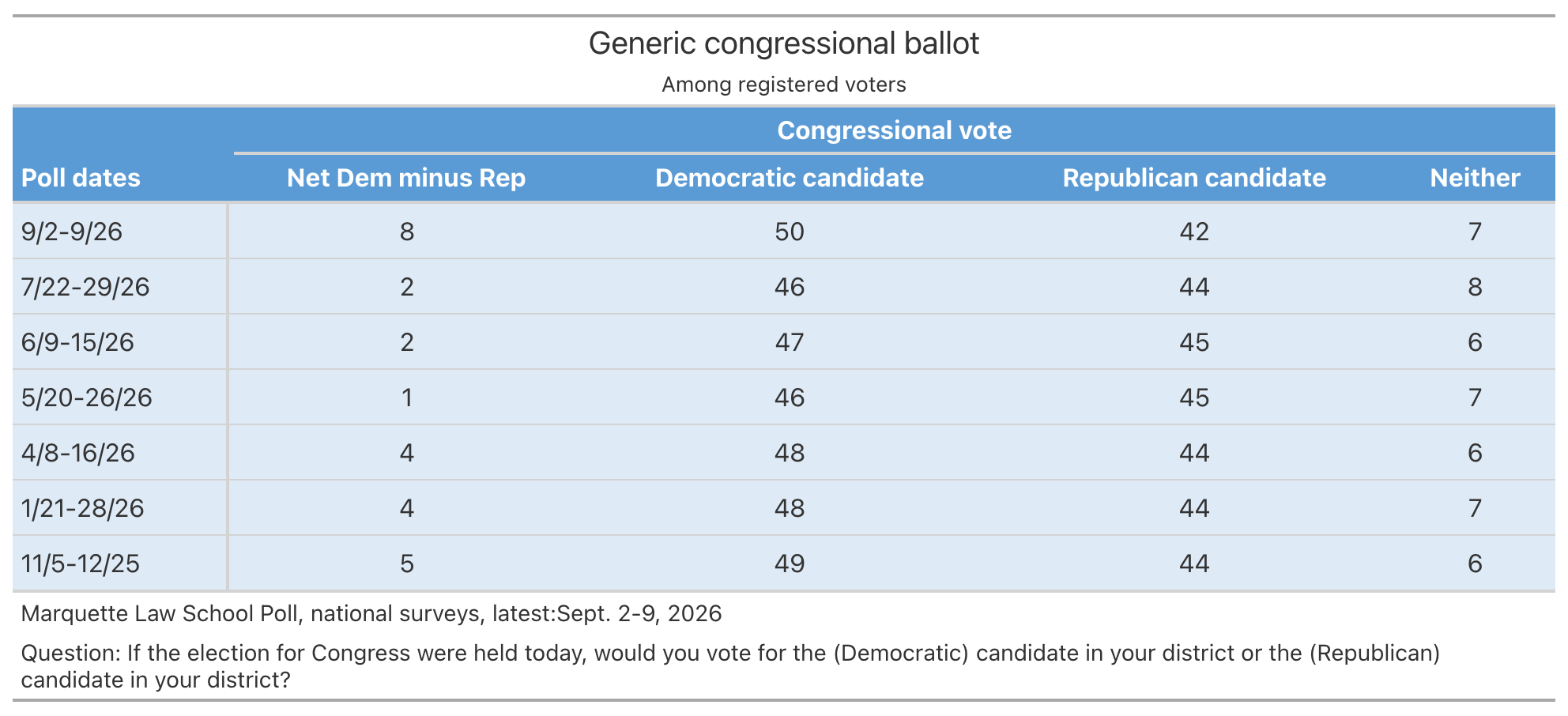
Among all registered voters, Democrats hold a 50% to 42% advantage over Republicans, a larger margin than the 46% to 44% gap in July’s Marquette Law School Poll, as shown in Table 2.
The survey was conducted Sept. 2-9, 2026, interviewing 1,023 adults nationwide, with a margin of error of +/-3.3 percentage points. For registered voters, the sample size is 864, with a margin of error of +/-3.6. For likely voters, the sample size is 581, with a margin of error of +/-4.3 percentage points.
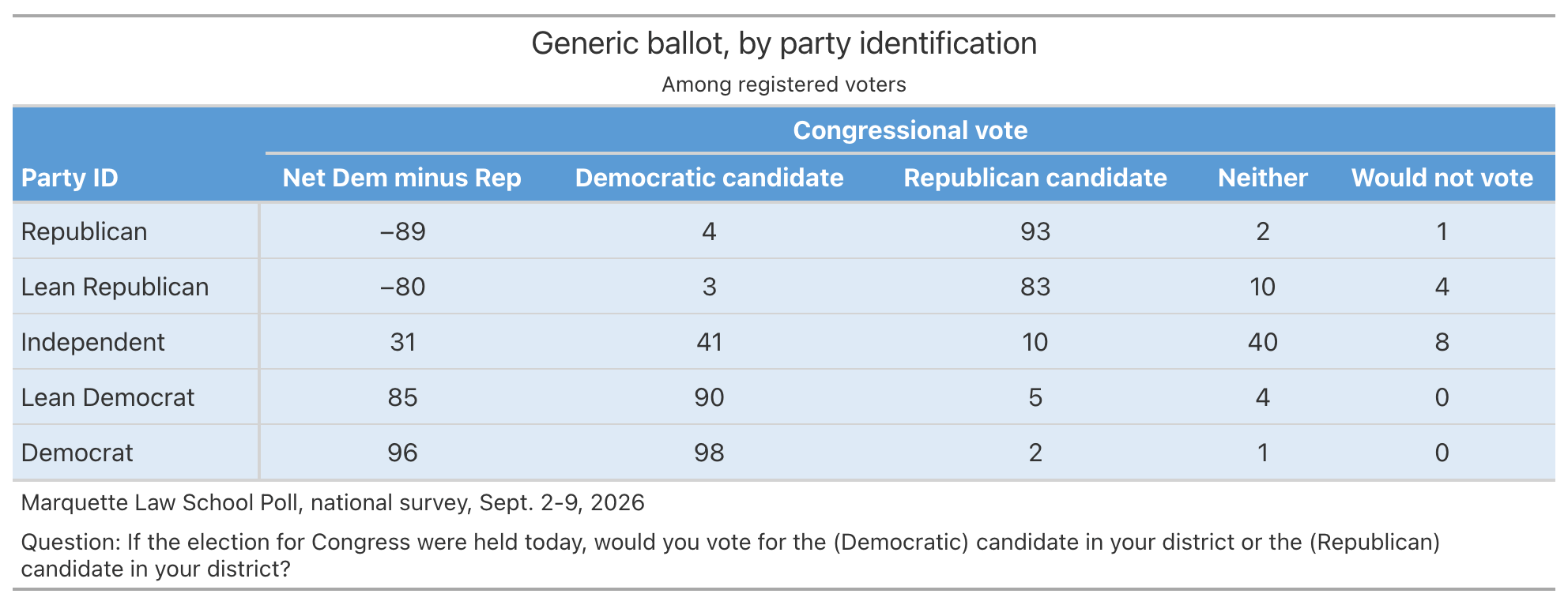
The Democratic advantages among all registered voters stem in part from stronger Democratic performance among independents, including both those who lean to a party and those who say they are not closer to either party. Among independents who lean to the Democratic Party, 90% support the Democratic Party candidate, while among independents who lean to the Republican Party, 83% say they will vote for the Republican congressional candidate and 10% are reluctant to vote for either candidate. Among independents who do not lean to either party, 41% favor the Democratic candidate and 10% the Republican, but 40% say they favor neither and 8% say they won’t vote.
In contrast, both Democratic and Republican partisans support their party’s congressional candidate at least 93% of the time, with very little crossover voting and with few saying they won’t vote, as shown in Table 3.
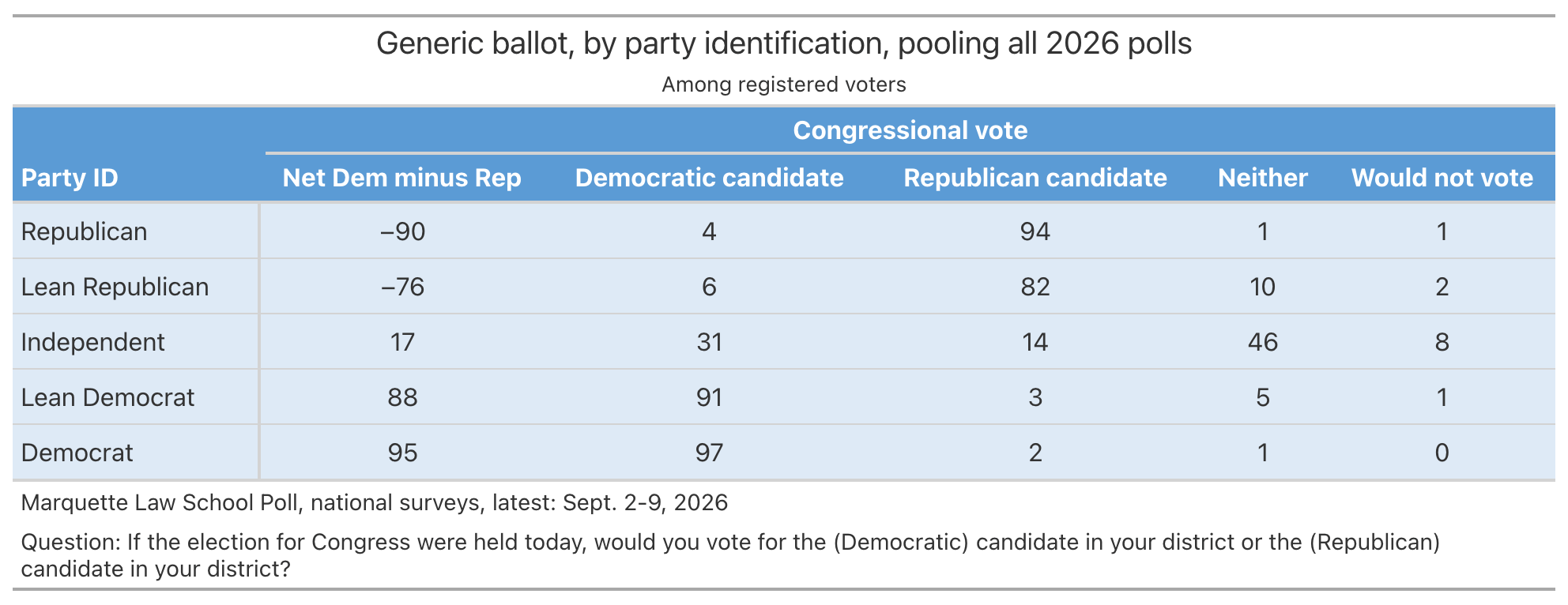
The substantial independent preference for Democratic congressional candidates is also seen when the six Marquette polls conducted in 2026 are combined, boosting the sample size and showing the September poll is in line with results all year. In the combined sample, 31% of independents favor the Democrat and 14% favor the Republican, while 46% say they prefer neither. The strong partisan loyalty seen in September is nearly the same in the combined polls, and those independents who lean to the Democratic Party report more Democratic votes than those who lean Republican favor the Republican candidate, as shown in Table 4.
Which party is better
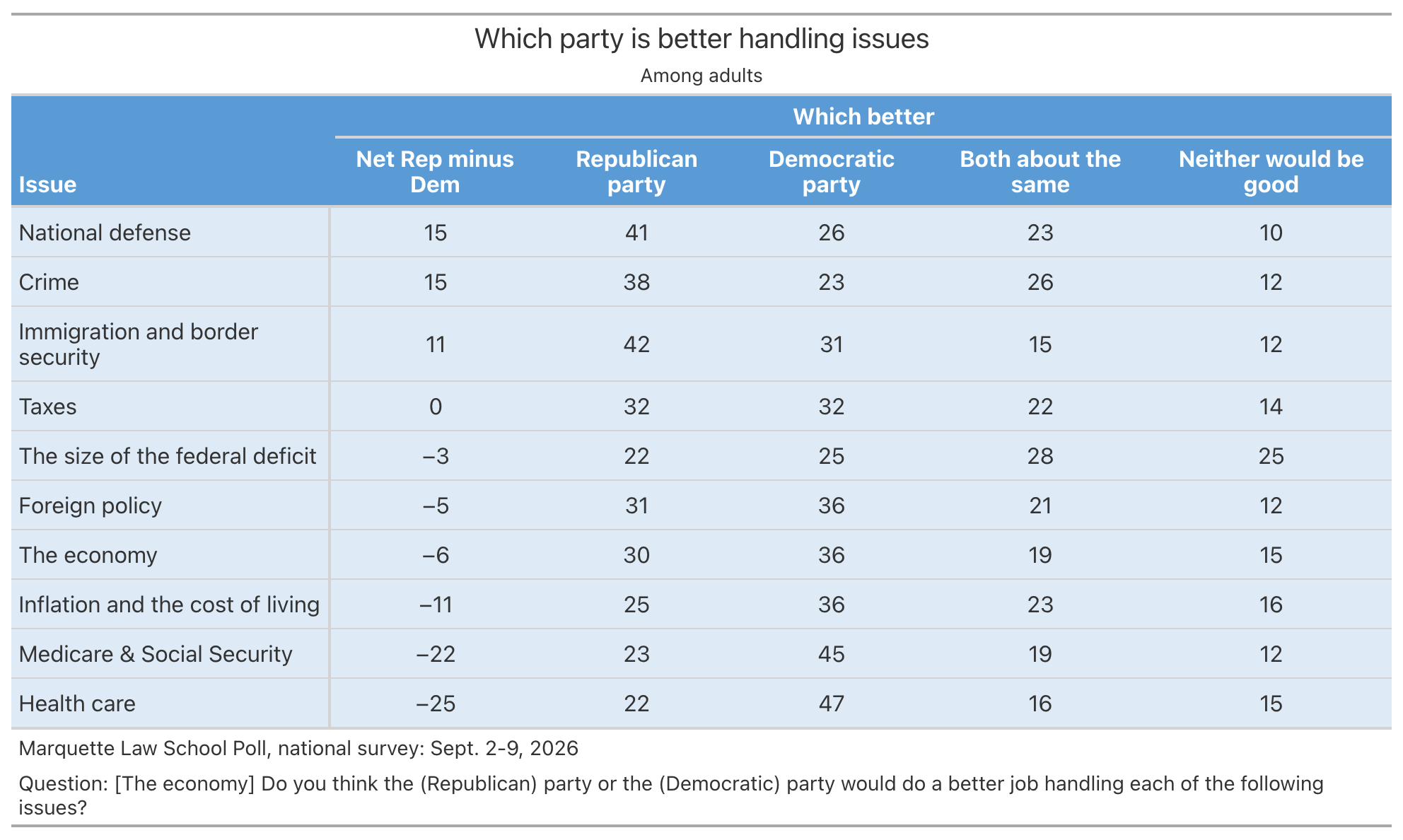
The Democratic Party is seen as doing a better job on six of 10 issues. Republicans are seen as better on three issues, and there is a tie on one. Democrats hold the advantage on the federal deficit, foreign policy, the economy, inflation, Medicare & Social Security, and health care. Republicans are seen as better on national defense, crime, and immigration and border security. The two parties are tied on which would handle taxes better, as shown in Table 5.
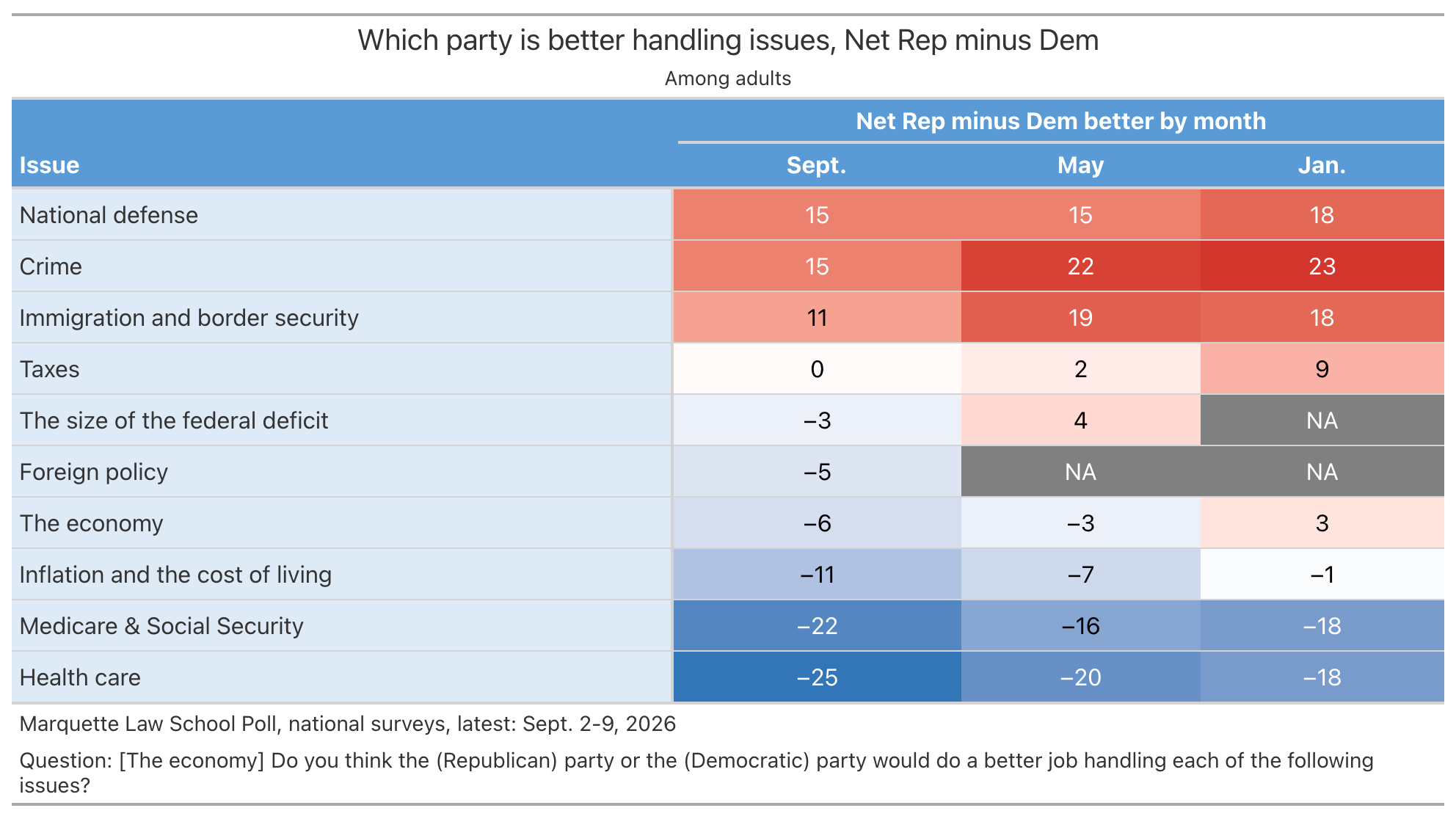
The Democratic advantage has grown across issues during 2026, while the Republican advantages have decreased. On each issue where Republicans are seen as better, the size of that advantage has declined since January, while each Democratic issue has seen a larger advantage over time. Table 6 shows the changes for each issue in 2026 polls.
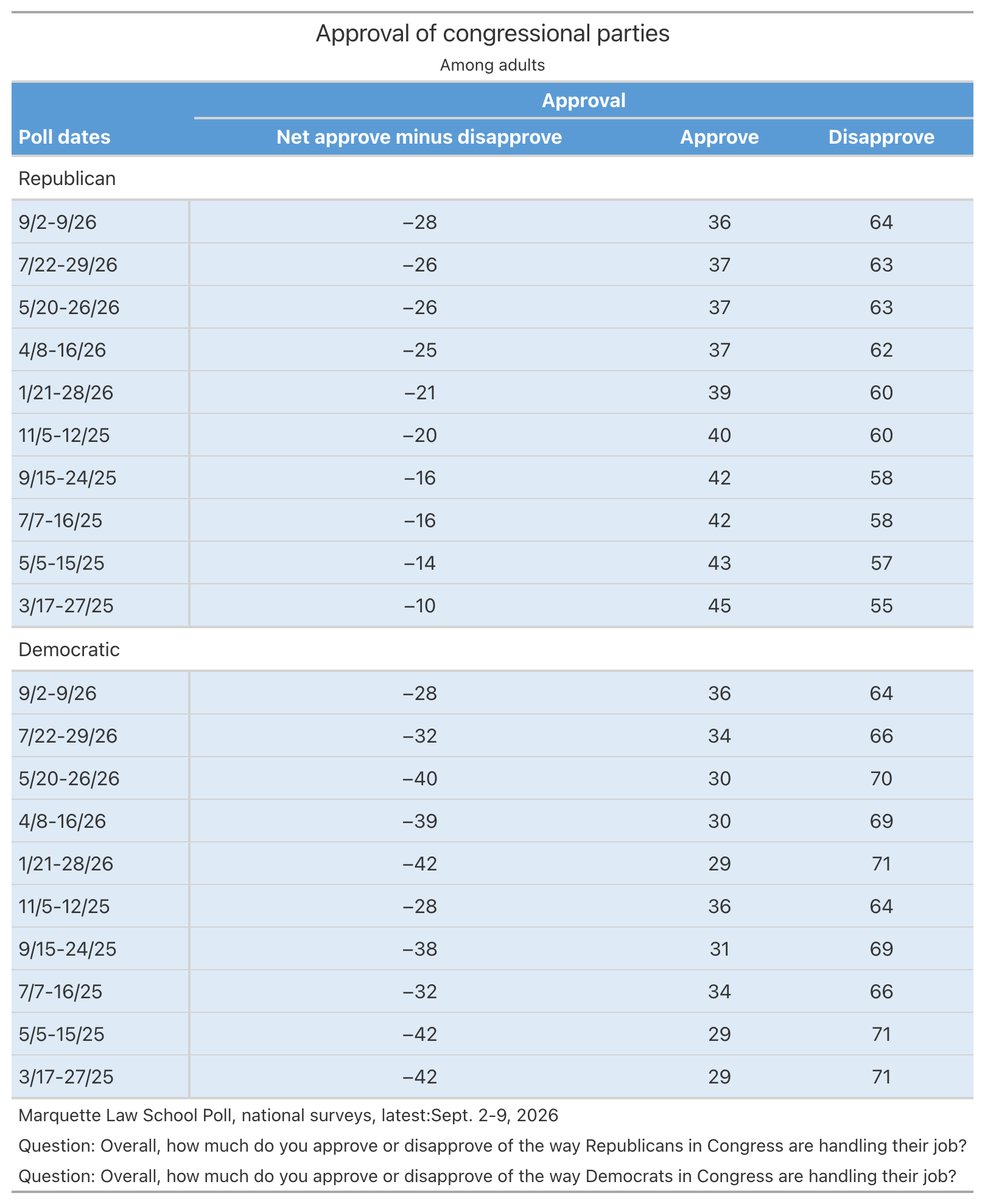
Approval of the parties in Congress has also shown similar trends. In September, 36% approve and 64% disapprove of how the Republican Party in Congress handles its job, and identical totals of 36% approve and of 64% disapprove of Democrats in Congress. Both parties have seen substantial majorities disapprove throughout President Donald Trump’s second term. However, there has been a change in the approval ratings of both parties. Over the term of the 119th Congress, Republican approval has fallen from 45% in March 2025 to 36% in September 2026, while Democratic approval has increased from 29% to 36%. Approval of each party is shown in Table 7.
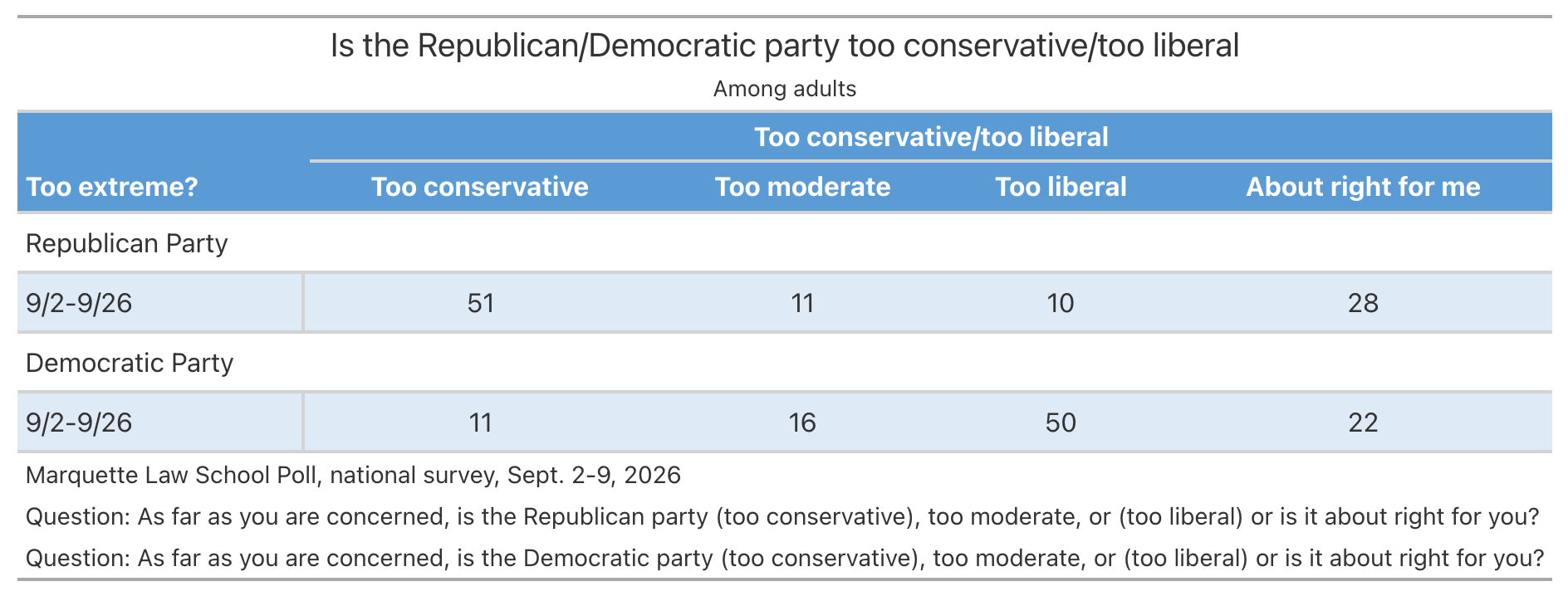
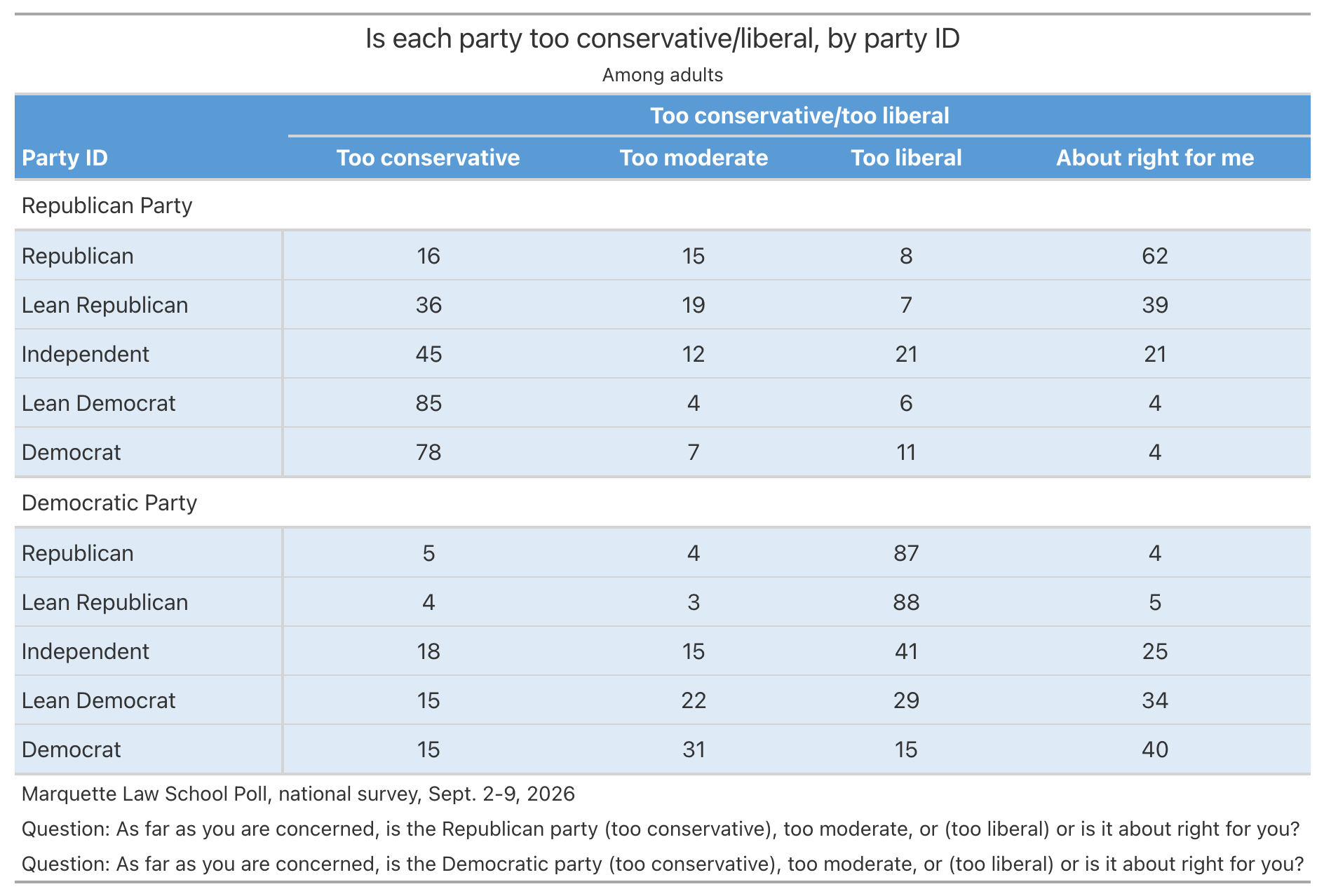
The Republican Party is seen as too conservative by 51% of adults, and the Democratic Party is seen as too liberal by 50%. About a quarter (28%) say the Republican Party is about right ideologically, and 22% say the Democratic Party is about right, as shown in Table 8.
Those who identify with the parties are more likely to say their party is about right for them, with 62% of Republicans and 40% of Democrats saying this. Those independents who lean to either party are somewhat less satisfied with the party ideologically, and a quarter or less of independents say either party is right for them. Among Democrats, 46% say the Democratic Party is too conservative or too moderate for them, while among Republicans, 23% say the Republican Party is too liberal or too moderate. This shows substantially more desire among Democrats for a leftward shift in the party than among Republicans for a rightward shift in theirs. This is shown in Table 9.
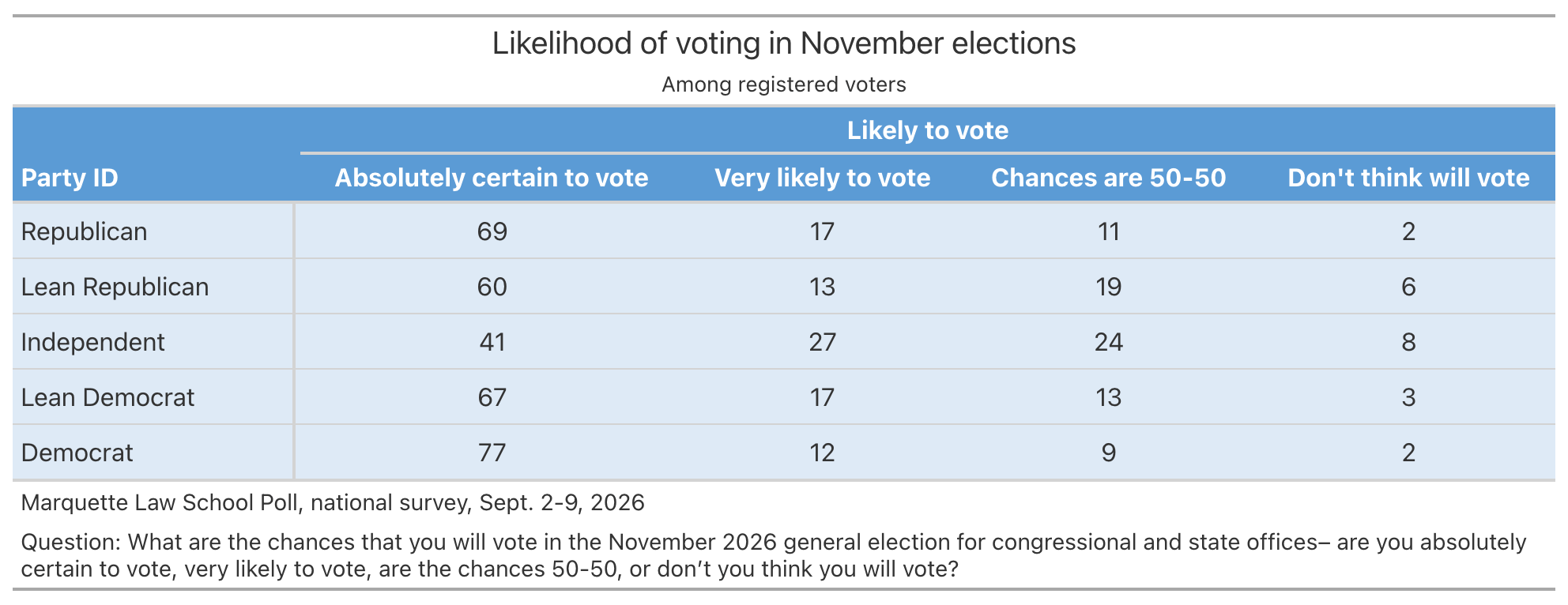
The Democratic advantage in congressional vote among likely voters is aided by higher expected turnout among Democrats than among Republicans. Among registered Democrats, 77% say they are certain to vote in November, versus 69% among Republicans. Likewise, among independents who lean Democratic, 67% say they are certain to vote, compared to 60% among independents who lean Republican. Independents who don’t lean to either party are substantially less likely to say they are certain to vote, with just 41% sure they will go to the polls. This lower turnout among “pure” independents reduces their influence in elections below their size among all registered voters. These results appear in Table 10.
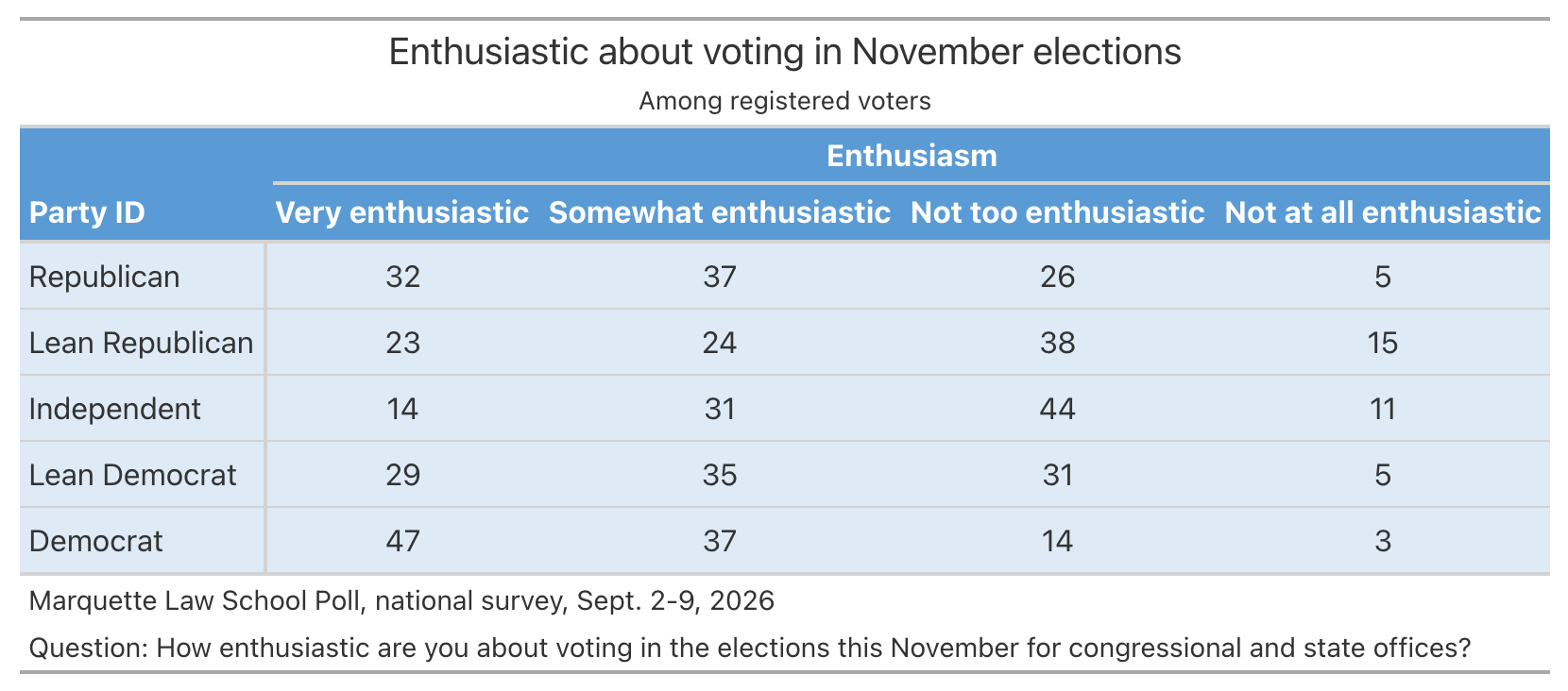
Democrats also enjoy an enthusiasm advantage going into the fall elections. Forty-seven percent of Democrats say they are very enthusiastic about voting in the election, compared to 32% of Republicans. There is a more modest enthusiasm gap among independents who lean to a party, with a 29% to 23% advantage for Democratic leaners over Republican leaners. As with certainty of voting, pure independents are by far the least enthusiastic about voting, with just 14% very enthused, as shown in Table 11.
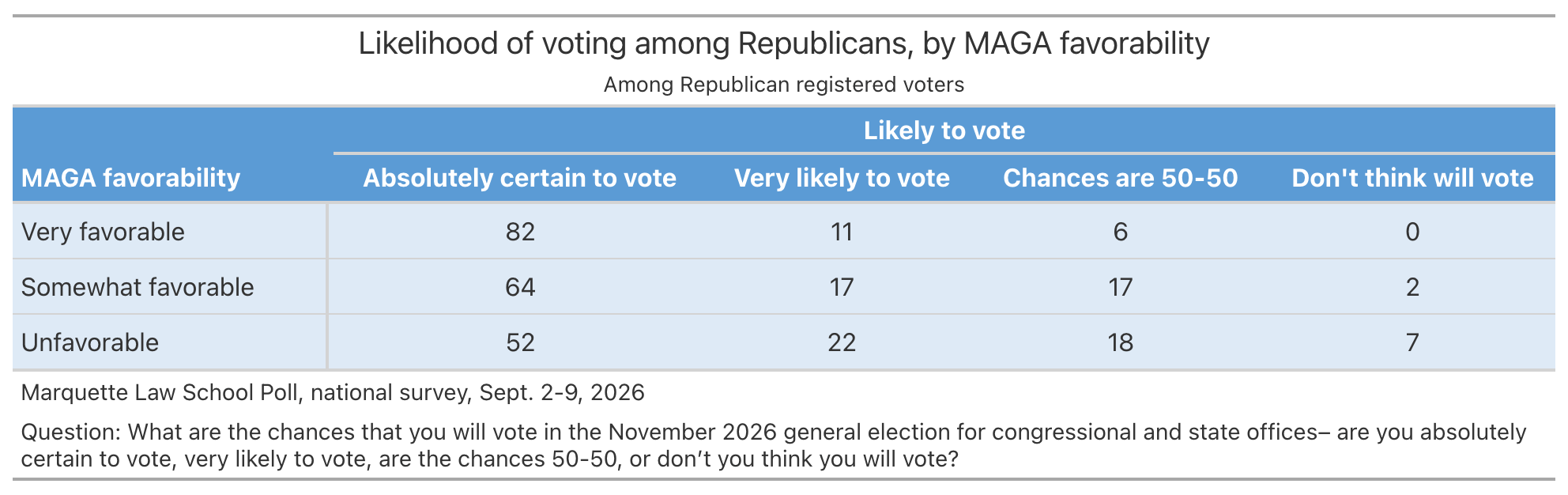
Among Republicans and independents who lean Republican, turnout is highest among those who are very favorable to the Make American Great Again (MAGA) movement, with 82% of them saying they are certain to vote. This falls to 64% for Republicans only somewhat favorable to MAGA and to 52% among those unfavorable to MAGA. This shows that the turnout issue among Republicans comes from those less attached to Trump’s loyal base of MAGA enthusiasts. These results are seen in Table 12.
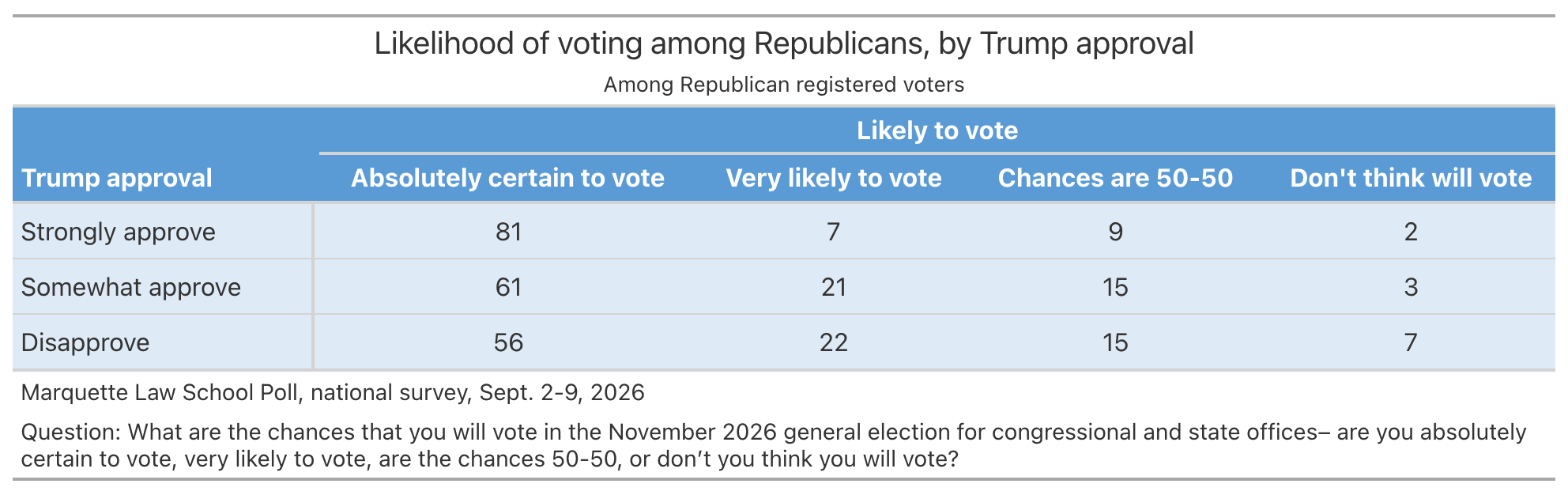
As with affection for MAGA, turnout among Republicans is strongly related to approval of Trump. Among those who strongly approve of the president, 81% say they are certain to vote, dropping to 61% among Republicans who somewhat approve and to 56% among those Republicans who disapprove of how Trump is handling his job. Among Republicans and independents who lean Republican, 36% strongly approve of Trump, 40% somewhat approve, and 24% disapprove (either somewhat or strongly). Turnout by approval is shown in Table 13.
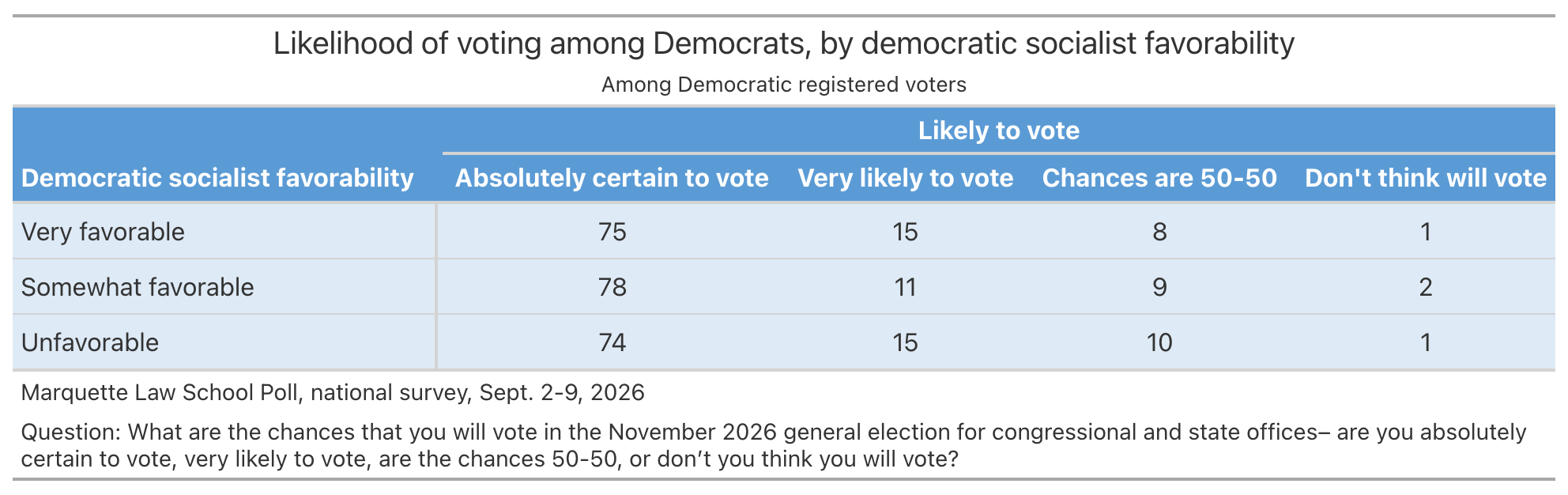
The Democratic Party has seen fresh competition from democratic socialists in primaries in 2026, creating new divisions within the party. However, these divisions are not associated with differences in turnout, such as are seen among Republicans. There is very little difference in expected turnout among Democrats regardless of how favorable or unfavorable they are to democratic socialist candidates, as shown in Table 14.
Concluding note
The Democrats have a substantial advantage on the generic ballot, especially among likely voters. While party loyalty is similar across parties, independent voters lean heavily in the Democratic direction on congressional vote. Democrats also enjoy a modest turnout advantage, though the lower turnout among independents mutes that groups influence. Enthusiasm also favors the Democrats. Finally, Republicans who are very favorable to MAGA or strongly approve of Trump are very likely to turnout. But for those less positive to MAGA or to Trump, turnout falls substantially. Among Democrats, feelings to democratic socialists are unrelated to turnout.
In Part 2, I turn to approval of Trump and the most important issues for voters.